Blog
Rugged Edge AI Computing: The Complete Guide

Military organizations have never had more data at their fingertips at the edge. From ISR platforms and autonomous systems to radar networks and cyber monitoring tools, modern operations generate an unprecedented volume of information. Yet despite advances in sensing and connectivity, many organizations face a growing challenge: turning data into actionable intelligence quickly enough to make a difference.
The problem is no longer data collection. The problem is data exploitation.
As artificial intelligence becomes a force multiplier across defense operations, organizations are increasingly moving AI processing closer to where data is generated. This shift, known as Edge AI, is transforming how military teams collect, process, and act on information in contested and time-sensitive environments.

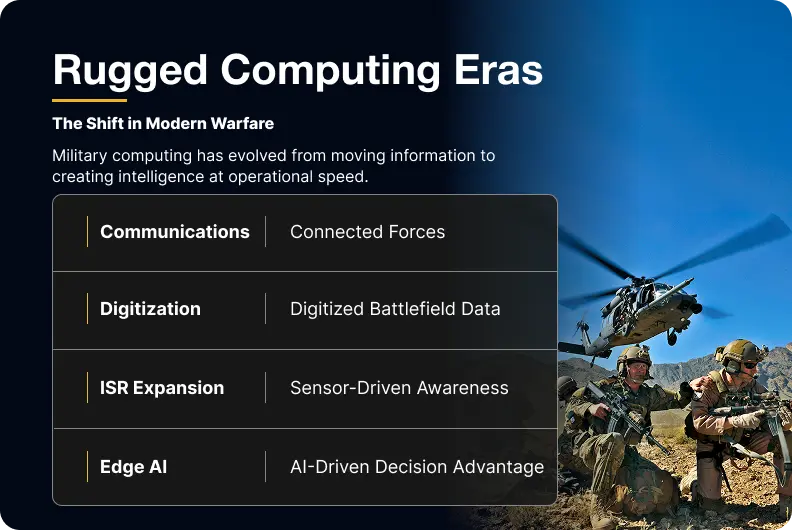
Military computing has evolved dramatically over the past several decades. Early systems focused on communications, enabling voice, messaging, and network connectivity across distributed forces. As technology advanced, digital maps, databases, and mission planning tools improved battlefield awareness.
The next phase came with the explosion of ISR capabilities. Sensors were deployed across land, air, sea, space, and cyber domains, creating an unprecedented level of visibility.
Today, the challenge is managing the resulting flood of information.
The latest evolution of military computing is focused on AI-powered exploitation, using advanced analytics, machine learning, and automated processing to transform raw data into operational decisions faster than ever before.
For years, modernization efforts centered on expanding access to information through more sensors, more platforms, and more connectivity.
Now organizations are asking different questions:
The reality is that analysts can no longer manually process the volume of information being generated by modern sensor networks. Information overload, analyst bottlenecks, and delayed decision cycles create operational challenges that demand a new approach.
Artificial intelligence provides that approach, but where AI processing occurs is just as important as the AI itself.
Traditional cloud and data center architectures excel in enterprise environments, but military operations introduce unique challenges.
When sensor data must travel long distances to centralized processing centers, organizations encounter:
In denied, degraded, intermittent, and low-bandwidth (DDIL) environments, centralized processing can become a liability. Every second spent transmitting data is a second lost in the decision-making process.
Edge computing changes the equation by processing information locally and transmitting only the intelligence that matters. The result is lower latency, improved resiliency, reduced bandwidth consumption, and stronger operational security.
Edge AI refers to deploying artificial intelligence capabilities close to the source of data generation rather than relying exclusively on centralized infrastructure.
In defense environments, this means AI models run directly on ruggedized computing platforms operating at the tactical edge.

A successful Edge AI architecture combines four critical layers:
1. Sensors
Data is collected from a wide range of sources including cameras, radar systems, communications networks, and unmanned platforms.
2. Compute
Rugged, GPU-accelerated systems process and fuse incoming data streams.
3. Artificial Intelligence
AI models analyze information, identify patterns, detect threats, and generate insights.
4. Operators
Actionable intelligence is delivered to decision-makers who can respond faster and with greater confidence.
When these layers work together, organizations gain the speed, awareness, and resiliency needed to succeed in modern operational environments.

No single sensor provides complete situational awareness.
Modern C5ISR operations increasingly rely on sensor fusion. Sensor fusion is the process of combining information from multiple sources to create a comprehensive understanding of the operational environment.
Common sensor inputs include:
When AI-powered systems fuse information across these domains in real time, operators gain a more complete picture of the battlespace.
The result is improved detection, reduced uncertainty, and faster decision-making.
In modern operations, the advantage rarely comes from having more information. It comes from processing information faster and turning it into action sooner than an adversary.
AI fundamentally changes the speed and effectiveness of every stage of the OODA Loop by reducing the time between data collection and operational response.
Observe: Processing More Data Than Humans Can
Today’s ISR ecosystems generate far more information than analysts can manually review. AI enables organizations to ingest and process massive volumes of sensor data in real time, identifying patterns, anomalies, and potential threats that might otherwise be missed.
Orient: Creating Context Across Multiple Domains
The challenge is rarely a lack of information—it’s understanding what the information means. AI-powered sensor fusion combines data from EO/IR sensors, radar, SIGINT, cyber systems, and unmanned platforms to create a unified operational picture. By correlating information across multiple sources, AI reduces uncertainty and helps operators establish context faster.

Decide: Delivering Actionable Intelligence
AI does not replace human decision-makers. It improves their ability to make informed decisions under pressure. By automating analysis, prioritizing threats, and generating recommendations, AI reduces cognitive workload and shortens the time required to evaluate options. Decision-makers can focus on mission objectives instead of manually processing data.
Act: Enabling Faster Operational Response
The value of intelligence is measured by how quickly it can be acted upon. When AI processing occurs at the tactical edge, intelligence can be delivered directly to operators, platforms, and command systems with minimal latency. This reduces delays caused by network congestion, bandwidth limitations, or centralized processing requirements.
The result is a faster transition from decision to execution.
The world’s most advanced AI platform is only useful if it can survive the mission.
Edge computing systems must operate reliably in environments characterized by:
Ruggedization ensures that mission-critical computing platforms remain operational when failure is not an option. For defense applications, rugged computing is not a feature, it is a requirement.
Different missions require different deployment strategies.
Common edge deployment models include:
1. Tactical Edge
Ideal for dismounted teams and ISR missions.
2. Vehicle-Mounted
Designed for mobile command-and-control operations.
3. Expeditionary
Supports temporary and rapidly deployed environments.
4. Fixed Site
Provides AI capabilities for command centers and permanent facilities.
Selecting the right architecture allows organizations to balance mobility, power, connectivity, security, and scalability.
As defense organizations continue adopting AI-powered capabilities, they need computing platforms purpose-built for operational environments.
The Core Systems ATMOS2 GPU was designed specifically to meet these demands.
Built for AI-powered C5ISR, C2NOW and compute-intensive workloads, the ATMOS2 GPU delivers:
By bringing powerful AI processing directly to the tactical edge, the ATMOS2 GPU enables organizations to transform raw data into actionable intelligence faster than ever before.

The future battlefield will generate more information, involve more sensors, and demand faster decisions. Organizations that can process, analyze, and act on data first will hold a significant operational advantage.
Edge AI provides the framework for achieving that advantage.
By combining ruggedized computing, GPU acceleration, artificial intelligence, and real-time analytics, defense organizations can move beyond data collection and focus on what matters most: making faster, better decisions when every second counts.
Core Systems designs and manufactures rugged military-grade computing platforms built for the realities of modern defense operations. From AI-enabled edge systems to mission-ready GPUs, our solutions help organizations deploy intelligence where it matters most.
Learn more about the ATMOS2 GPU and discover how Core Systems can help accelerate your mission.