Blog
Beyond the Factory Floor: How Rugged Servers Power Critical Infrastructure from Energy to Smart Cities

Industrial computing is no longer confined to climate-controlled data centers. It is now placed in the field, on rooftops, in remote substations, along coastal platforms and inside transportation corridors. As infrastructure becomes more connected, more automated, and more dependent on real-time information, rugged servers have taken on a central role in keeping operations stable and secure.
This shift is not just technological. It reflects a broader movement toward distributed intelligence, local processing and systems that can make decisions closer to the source. From utilities and energy production to public safety and smart city networks, modern infrastructure increasingly relies on computers that must survive environments far harsher than any office or cloud facility.
Many critical systems that once relied on centralized control now depend on robust compute power spread across the field. These deployments support:
Each of these areas produces data that must be processed in real time, often with limited or inconsistent connectivity. Traditional hardware tends to fail under heat, vibration, moisture, or electrical interference. Cloud systems struggle with latency and cannot always deliver the immediate feedback that many industrial tasks require.
To overcome these barriers, organizations are turning to rugged edge servers that are purpose built for the conditions where they must operate.
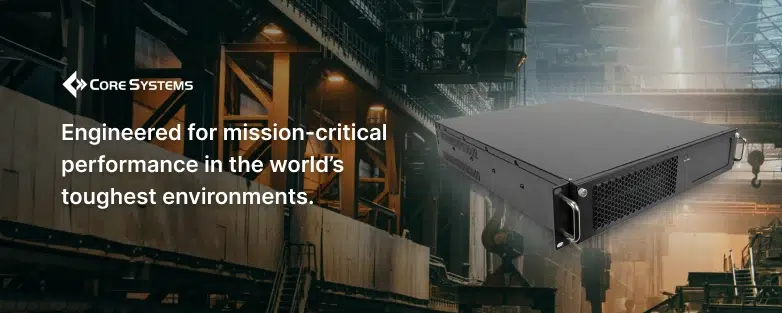
Field systems often operate around the clock in places where weather, shifting temperatures or mechanical forces are constant concerns. Rugged servers handle these realities through reinforced enclosures, industrial components and thermal designs that allow them to function:
These edge systems also support higher performance workloads such as:
When the cost of downtime is high, rugged compute becomes more than a convenience. It becomes a protective layer across the entire infrastructure.
Across industrial sectors, unexpected outages carry significant financial and operational consequences. Independent studies provide a clear picture of the impact:
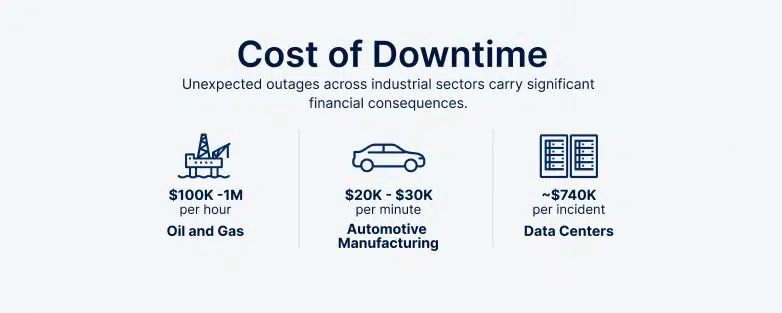
* Resources: Oil and Gas, Automotive, Data Centers
These numbers illustrate why organizations invest in equipment that can operate without interruption. Rugged servers extend system life, cut unplanned maintenance, reduce site visits, and protect productivity. In many cases, their cost is small compared with the financial exposure of a single outage.
Energy production sites face some of the most unforgiving conditions. Rugged edge servers now support:
With local computing in place, operators can maintain uptime and safety even when connectivity is limited.
The modern city runs on data. Everything from traffic flow to lighting to environmental controls depends on timely information. Rugged servers sit at intersections, utility poles and roadways where they run:
Since outdoor systems face heat, cold and moisture, rugged hardware ensures continuous service where residents depend on it most.
Telecom providers are building dense networks that require local compute in:
Rugged servers support ultra-low latency delivery, IoT expansion, autonomous vehicle connectivity, and private industrial networks.

Rail operators, maritime fleets, and aviation systems require computer hardware that can tolerate vibration, shock, and long duty cycles. These environments use rugged servers for:
Reliable computing keeps transportation networks moving safely and efficiently.
The true value of rugged compute is not only in performance. It is in the avoidance of losses. Rugged systems reduce:
As operations become more automated and more data dependent, rugged servers offer a stable foundation that protects both productivity and safety.
The next generation of infrastructure is built around edge AI, distributed analytics, resilient networks, and systems that cannot afford interruptions. Cloud computing will remain essential, but the most critical decisions will be made closer to the assets themselves.
Rugged servers are positioned to support this shift. They give industries reliable, high-performance computing where the work happens, whether on an offshore platform, at a roadside cabinet or inside a remote utility station. Far from being niche, they are becoming a core requirement for modern industrial transformation.