Blog
AI and Edge Computing for Real-Time Tactical Decision-Making

Most military systems are still designed as if connectivity is guaranteed.
In real operations, it rarely is.
Decisions are often required in seconds, sometimes faster, and frequently in environments where networks are degraded, denied, or intentionally disrupted. When architectures depend on constant reach-back to centralized infrastructure, those delays become operational risks.
That reality is reshaping how the Department of Defense and the defense industrial base think about AI and computing. Edge computing and on-node AI are no longer experimental concepts. They are becoming foundational to decision-making in contested environments.
DoD modernization efforts consistently emphasize speed, relevance, and resilience. Those goals are driven by conditions operators face every day.
Latency has consequences. ISR data and AI insights lose value when they arrive too late to influence action.
Bandwidth is limited. High-resolution sensors and multi-modal data streams cannot always be pushed back to a cloud or enterprise network.
Connectivity is uncertain. Electronic warfare, cyber activity, terrain, and platform mobility routinely disrupt communications.
Together, these factors explain why programs are moving toward distributed compute and local AI inference. Systems must continue to operate when disconnected, not pause until the network recovers.
AI that depends on the cloud is difficult to apply tactically.

Edge computing brings processing closer to where data is generated. Instead of transmitting raw sensor data upstream, systems analyze it locally and deliver only what is relevant.
This supports real-time AI inference, sensor fusion, and analytics at the tactical edge. It also reduces bandwidth demands and improves resilience when networks are degraded or unavailable.
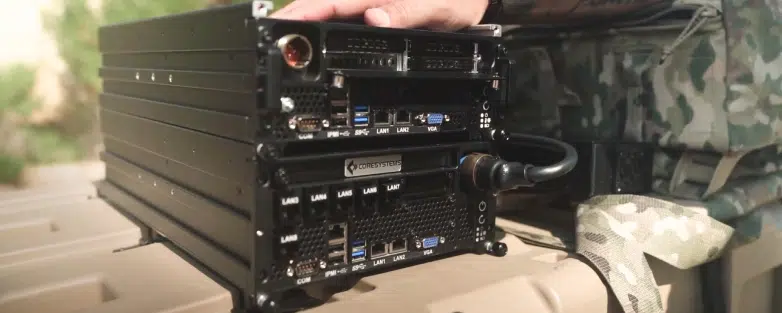
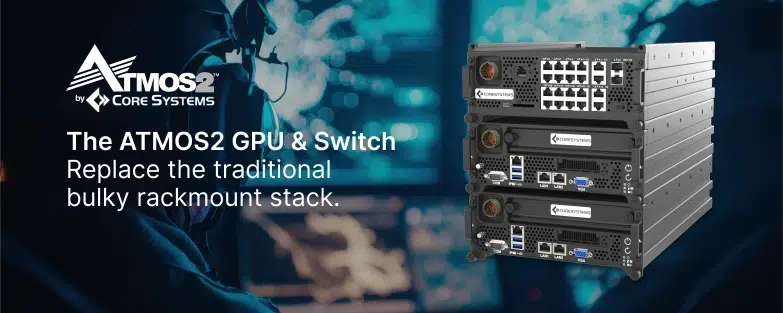
Ruggedized edge platforms such as the ATMOS2 Series are designed for this role. They provide sustained processing and AI inference in vehicle-mounted, command post, and forward-deployed environments where space, power, and cooling are constrained.
The cloud still has a role, but missions cannot depend on it.
Operational timelines do not pause for network access.
Edge architectures are built around a simple requirement. Systems must process information locally and present actionable results immediately.
That includes not only compute at the edge, but also how information reaches human decision-makers.
Effective edge architectures separate responsibilities while remaining tightly integrated.
Tactical edge computers handle AI inference, analytics, and sensor fusion close to the source.
Operator-facing systems provide a direct interface to that processed data. Mobile platforms such as the RPS417 rugged laptop allow operators to visualize results, assess AI outputs, and act without relying on centralized dashboards or remote connectivity.
The flow is straightforward. Data is processed locally. Information is presented clearly. Decisions are made in real time.
For primes and system integrators, edge AI changes how systems must be designed.
Architectures should assume periods of disconnection as a normal condition. Compute platforms must be mission-hardened rather than adapted from commercial IT. AI strategies must prioritize inference at the edge, not just model development.
Human-machine integration matters just as much as performance. AI outputs must be usable by operators under time pressure and uncertainty.
Industry reporting reflects this shift. Military and Aerospace Electronics has noted growing demand for edge processing driven by the need to analyze data locally where connectivity cannot be assumed.
The future of tactical AI is distributed.
Latency is not just a technical metric. It affects outcomes. Bandwidth is constrained. Connectivity is never guaranteed.
Systems that process, inform, and enable decisions at the edge are better aligned with how missions actually unfold.
Decisions do not wait for connectivity.