Blog
NGC2 Computing: The Complete Guide

Military command and control is evolving to deliver decision superiority by connecting sensors, shooters, and commanders across domains. As the DoD advances NGC2 and CJADC2, technologies such as MOSA, C2NOW, edge computing, AI at the tactical edge, and sensor fusion are enabling more resilient, interoperable, and data-driven operations in contested environments.

NGC2 (Next Generation Command and Control) is a modern approach to military command and control that connects people, sensors, platforms, and decision-makers through data-driven, software-enabled, and distributed computing architectures.
Unlike traditional command and control systems that relied heavily on centralized infrastructure, NGC2 emphasizes:
Rather than being a single program or product, NGC2 represents the evolution of how information is collected, processed, shared, and acted upon across modern military operations.
Modern operations generate enormous amounts of information from sensors, autonomous systems, communications equipment, and intelligence sources. The challenge is no longer collecting data, it’s turning that data into actionable decisions before opportunities disappear.
NGC2 addresses this challenge by enabling:
The ultimate objective is to shorten the time between observing an event and taking action.
Traditional command and control systems often relied on centralized headquarters, fixed infrastructure, and sequential decision-making. While effective for many missions, they can become constrained by bandwidth limitations, communication delays, and growing volumes of operational data.
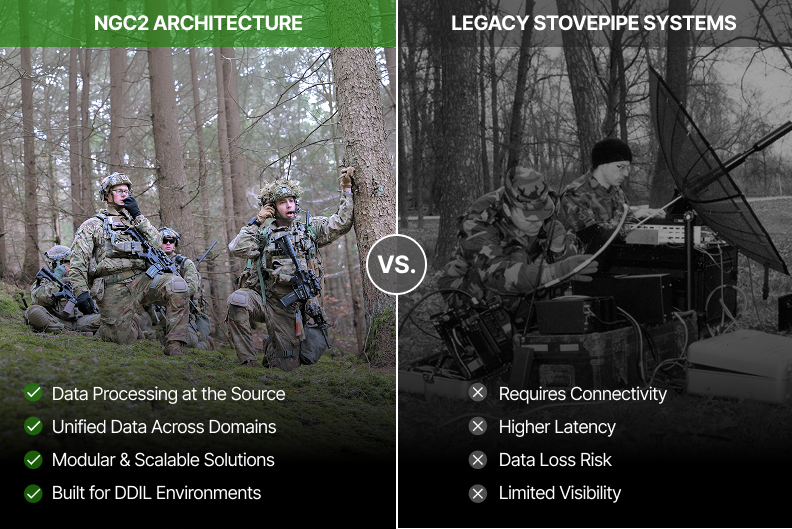
NGC2 shifts intelligence and decision support closer to where operations occur by distributing compute resources throughout the tactical environment. Information can be processed locally, enabling faster responses even when communications are limited or intermittent.
Combined Joint All-Domain Command and Control (CJADC2) is the Department of Defense’s vision for connecting forces across land, air, sea, cyber, and space while enabling coalition interoperability.
CJADC2 focuses on ensuring the right information reaches the right decision-makers at the right time regardless of service branch or operational domain.
NGC2 computing provides much of the distributed computing foundation required to support this vision by enabling information to be processed and shared closer to where it is generated.
C2NOW is an operational modernization initiative focused on accelerating command and control capabilities through advanced computing, networking, and software technologies.
The initiative emphasizes:
As organizations continue modernizing command and control environments, initiatives like C2NOW demonstrate the growing importance of scalable, interoperable edge computing infrastructure.
MOSA (Modular Open Systems Approach) is a design philosophy that promotes modular, standards-based systems instead of proprietary architectures.
Rather than replacing entire systems when requirements evolve, MOSA enables organizations to upgrade individual hardware and software components while maintaining interoperability.
Key advantages include:
For organizations building NGC2 capabilities, MOSA helps ensure systems remain adaptable as missions and technologies evolve.
Several standards support the broader MOSA strategy.
SOSA™ (Sensor Open Systems Architecture) defines common hardware approaches that improve interoperability between sensor processing and computing systems.
CMOSS (C5ISR/EW Modular Open Suite of Standards) focuses on integrating communications, electronic warfare, positioning, and mission computing into modular architectures.
Together, these initiatives help create hardware ecosystems that can evolve without requiring complete redesigns.
Edge computing places computing resources close to where data is generated rather than relying exclusively on centralized data centers or cloud infrastructure.
Instead of transmitting every piece of sensor data back to distant servers, information can be processed locally-reducing latency, conserving bandwidth, and improving responsiveness.
Common edge computing applications include:
Cloud computing remains valuable for large-scale analytics, long-term storage, and enterprise applications. However, military operations frequently occur in environments where cloud connectivity is unavailable, unreliable, or contested.
Edge computing addresses these challenges by allowing systems to continue operating independently when communications are degraded.
Benefits include:

Rather than replacing cloud computing, edge computing complements it by ensuring critical processing remains available where and when it is needed most.
Artificial intelligence is becoming an essential component of modern command and control because it helps operators process information faster than manual analysis alone.
Running AI directly at the tactical edge enables organizations to:
Processing AI workloads locally also minimizes delays caused by transmitting large amounts of raw data across constrained networks.
Tactical edge computing refers to deploying rugged computing resources directly within operational environments where missions occur.
These systems often support:
By placing compute resources closer to operators and sensors, tactical edge computing improves responsiveness while reducing dependence on centralized infrastructure.
A rugged edge server node is purpose-built to operate reliably in demanding environments where commercial data center hardware would be unsuitable.
Typical characteristics include:
These systems provide the computing foundation required to support modern NGC2 applications across diverse operational environments.
Modern military workloads increasingly rely on parallel processing capabilities that traditional CPUs alone cannot efficiently provide.
GPUs accelerate workloads such as:
As AI adoption continues to grow, GPU-enabled edge computing has become a foundational capability for many NGC2 architectures.
Modern NGC2 computing environments typically integrate multiple technologies working together.
These commonly include:
The objective is to create a flexible architecture capable of supporting evolving mission requirements without requiring complete system replacement.
Artificial intelligence enhances command and control by helping operators identify patterns, prioritize information, and make faster decisions.
Common applications include:
AI is not intended to replace operators—it augments human decision-making by reducing the time required to analyze complex operational data.
Sensor fusion integrates data from various sources such as radar, EO/IR cameras, communication systems, and additional sensors to create a cohesive operational overview.
Instead of evaluating each sensor independently, modern computing platforms correlate data automatically to improve situational awareness and reduce information overload.
This capability becomes increasingly important as the number and diversity of connected sensors continue to grow.
Multi-Domain Operations (MDO) coordinate capabilities across land, air, sea, cyber, and space to achieve mission objectives.
Supporting MDO requires computing systems capable of securely processing and sharing information between diverse platforms while adapting to changing operational conditions.
NGC2 computing provides much of the infrastructure needed to enable these connected, distributed operations.
Successful NGC2 implementations balance performance, interoperability, resilience, and long-term adaptability.
Important considerations include:
Selecting technologies designed around these principles helps organizations modernize more efficiently while protecting future investments.
NGC2 represents more than a technology upgrade, it reflects a fundamental shift in how military organizations collect, process, and act on information.
As missions become increasingly distributed and data-intensive, the ability to process information at the tactical edge, integrate AI, and operate across open, interoperable architectures will continue to shape the future of command and control.
Organizations that invest in flexible, modular edge computing platforms today will be better positioned to adapt as operational requirements evolve, ensuring they can deliver timely information, support faster decisions, and maintain mission effectiveness across tomorrow’s contested environments.